The plan, 2 of 3
Women in the profession: ownership, not titles
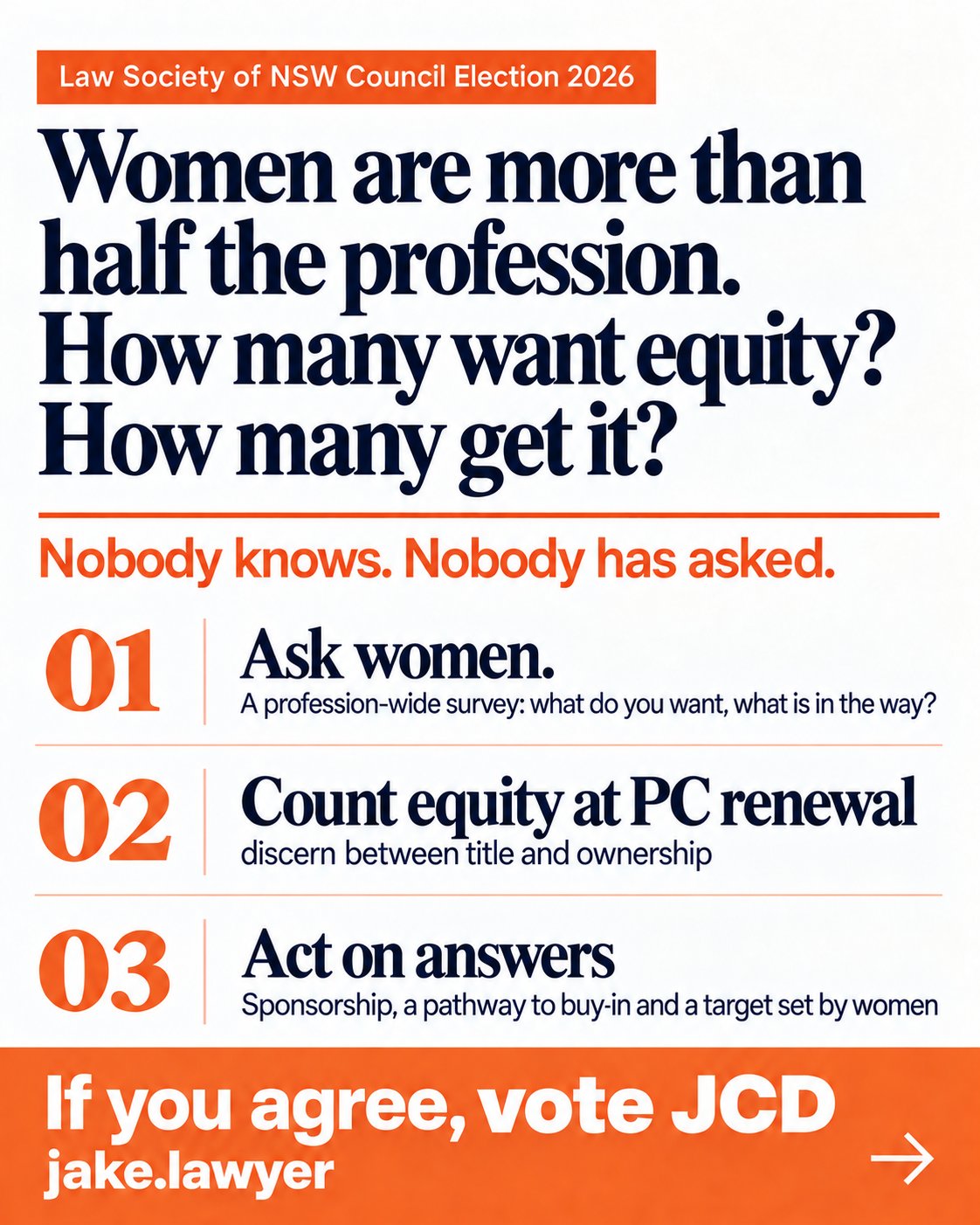
Women have been the majority of NSW solicitors since 2017. Nobody has asked them what they want from the profession, and nobody counts who owns the firms they work in.
The numbers
All of these come from the Law Society's own Annual Profile of Solicitors, the 2025 edition unless stated. They measure headcount and title. None of them measures ownership.
- Women are 56 per cent of NSW solicitors, and have outnumbered men every year since 2017.
- Women are 37 per cent of partners and principals in private practice. In 2013 the figure was 24 per cent. It has moved about one point a year.
- A quarter of women in private practice are principals of their practice. For men it is almost half (25 per cent against 46 per cent).
- Of 7,388 private practices in NSW, 4,727 have a single solicitor. Forty-four per cent of all principals are sole principals. For close to half the principal population, "principal" means running a practice alone, not holding equity alongside others.
On the current trend, women would be about 42 per cent of principals by 2030 and reach parity around 2040. That is a straight-line projection from the Society's series, not a Society forecast, and it holds only if nothing changes.
The Society counts equity and salaried principals as one category. It has never separated them, so nobody can say how many of the 37 per cent own anything.
Ten years on
These are statements about what documents say. They are not criticisms of any person.
- 2014. The Law Council's National Attrition and Re-engagement Study, on 2013 fieldwork, found that "attrition and stalled progression to senior levels within the legal profession due to family responsibilities was identified as a key issue for women". It recommended that professional bodies "collect and publish ongoing standardised data on the attrition of outgoing members". One industry body told the researchers: "If you're just relying on their goodwill, then nothing will happen." The survey asked respondents whether they were equity or salaried partners. The report never published the split.
- 2016. The Society launched the Charter for the Advancement of Women, relaunched in 2021. Its eight commitments are all about culture and behaviour. It sets no target, asks signatories to report nothing, and says nothing about ownership, buy-in or succession. The Charter does not appear in the Society's 2025 Annual Report.
- 2020. The Society's Gender Statistics page still carries figures from the 2020 Profile and no figure for principals, partners or owners.
- 2023. The Society's own paper on equitable remuneration recommended that firms report equity and non-equity partners separately. Three years on, the Society's Annual Profile still does not.
- 2025. The Society's own Workplace Gender Equality Agency return records no gender equality targets, a pay gap analysed three ways within the year, and no action taken as a result.
The Practising Certificate Survey, the Society's annual questionnaire at renewal, is voluntary, drew a 38 per cent response in 2025-26, and cannot be linked to a firm. The principal figures above come from the practising certificate database itself, which is compulsory and complete. That is where the equity question belongs.
Three steps
I am not going to tell women what they should want. Maybe it is equity. Maybe it is something else. The point is that nobody has asked, and nobody has counted. So the plan is deliberately modest, and every step has a number that can be checked twelve months later.
-
Ask women.
A profession-wide survey run by the Society: what do you want from your career, and what is in the way? The last national study asked in 2013. Nothing since has asked NSW women directly, and nothing has asked about ownership.
-
Count equity, not titles.
One question at practising certificate renewal: do you hold equity in the practice? Published every year by gender and firm size, with equity reported separately from salaried principals. Council already imposes conditions on an individual's certificate, the Practice Management Course being the working example, and the registry data is already collected for the stated purpose of research. This uses a power the Society has and data it already holds.
-
Act on the answers.
A Society-backed sponsorship program that pairs women approaching partnership with equity partners in other firms who will advocate for them. Buy-in tools: a model incorporated practice constitution for staged and minority shareholdings and a standard valuation schedule for firms of one to ten principals. A succession register matching retiring principals with solicitors ready to buy in. And a target, if there is to be one, set from what the survey says women want, not imposed on them.
What Council can do, and what it cannot
Council manages the business of the Society and may exercise all of its powers. Publishing what the Society already collects, running a cohort analysis from the register, and drafting precedents need no further source of power. A declaration by an individual principal at renewal sits within the condition power that already exists. Compelling a firm, as distinct from an individual, to lodge workforce data is a different matter, and I have not found a power that supports it. I would rather say that plainly than promise something Council cannot deliver.
Two routes exist. A Councillor can move a motion. Or 250 members can requisition a general meeting under clause 10.3 of the Constitution, with a memorandum for and against circulated to every member. If Council will not move, members can.
Sources
- Law Society of NSW, 2025 Annual Profile of Solicitors in NSW (Urbis, July 2026, data as at 30 June 2025); 2024 Annual Profile (June 2025), which publishes the 2013 to 2024 series for female partners and principals.
- Law Council of Australia, National Attrition and Re-engagement Study Report (Urbis, dated February 2014; fieldwork May 2013).
- Law Society of NSW, Charter for the Advancement of Women and Guidelines (2016; relaunched 2021); Annual Reports 2021 to 2025.
- Law Society of NSW, Equitable Remuneration in the Legal Profession (September 2023).
- Law Society of NSW, Workplace Gender Equality Agency Employer Public Report 2024-25 (signed 9 May 2025).
- Constitution of the Law Society of New South Wales (as amended 27 October 2022), clauses 10.3, 14.1.1 and 14.1.2; Legal Profession Uniform Law (NSW) s 53; Legal Profession Uniform General Rules 2015 r 16(b)(ii); practising certificate application 2026-27, collection notice.
Two corrections to earlier campaign material, for the record: women first outnumbered men among NSW solicitors in 2017, not 2016 (in 2016 the count was 15,085 men to 15,065 women), and the 29 per cent and 52 per cent figures quoted earlier were principal status by gender in the 2024 edition, which the 2025 edition puts at 25 and 46 per cent. They were never ownership figures, because the Society does not collect any.
If you agree, vote JCD
- Voting closes 2.00pm Monday 19 October 2026.
- The ballot paper lists candidates by full name: Jacob Carswell-Doherty.